Blogs
Helping Students Navigate Political, Cultural, and Social Change

A School Counselor’s Guide to Leadership, Stability, and Student Support
Introduction: When the World Enters the School Building
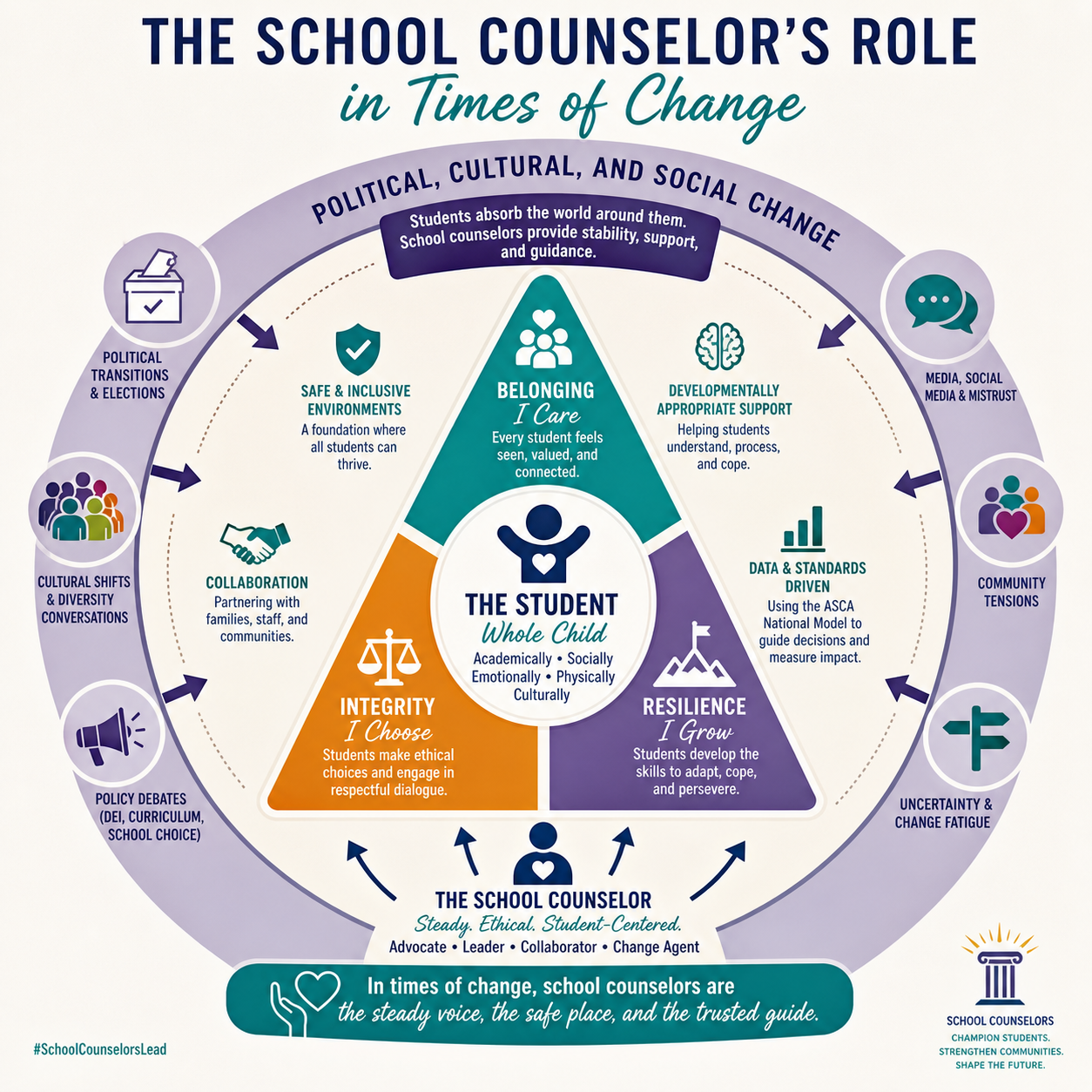
Students do not leave the world at the schoolhouse door. Political transitions, cultural shifts, and social tensions inevitably find their way into classrooms—making the role of school counselors navigating political, cultural, and social change more essential than ever.
This is where school counselors step forward—not as political voices, but as stabilizing leaders grounded in ethics, equity, and student well-being.
This pillar blog (a comprehensive, in-depth resource that brings together multiple related topics into one central guide—unlike the regular blog post that focuses on a single idea—serving as a hub that links to and organizes supporting articles) brings together key insights on how school counselors can:
- Maintain safe and inclusive environments
- Navigate policy shifts with professionalism
- Support student identity and belonging
- Uphold ethical practice in politically charged contexts
Why This Matters: The Counselor as a Steady Anchor
In times of change, students need:
- Consistency in adult responses
- Safety in expressing thoughts and emotions
- Guidance in separating fact from fear
- Belonging regardless of background or beliefs
School counselors are uniquely positioned to provide this through:
- Direct student services (Tier 1, 2, and 3)
- Schoolwide leadership and advocacy
- Collaboration with families and staff
Understanding the Landscape of Change in Schools
1. Political Transitions and Elections
Elections often bring:
- Heightened emotions at home and in media
- Increased student anxiety or confusion
- Polarizing language that students may repeat
Key Insight:
Students are not reacting to policy. They are reacting to how adults around them respond to policy.
2. Cultural Shifts and Diversity Conversations
Today’s students are growing up in increasingly diverse environments while simultaneously encountering:
- Conflicting narratives about identity and history
- Policy changes related to DEI initiatives
- Community-level tensions
Key Insight:
Belonging is not a political issue. It is a developmental necessity.
3. Policy Debates (DEI, School Choice, Curriculum)
As school counselors navigate political, cultural, and social change, their role must remain grounded in ethics, student well-being, and the ASCA National Model. School counselors may feel tension when:
- Policies shift quickly or conflict with training
- Expectations blur between educational roles and political pressures
- Advocacy feels risky or misunderstood
Key Insight:
The ASCA National Model provides clarity when external messaging does not.
The School Counselor’s Role: Grounded in the ASCA National Model
School counselors are not political agents. They are student advocates guided by ethics and standards.
Core Responsibilities in Times of Change
1. Maintain Safe and Inclusive Environments
- Ensure all students feel physically and emotionally safe
- Address harmful language or behavior immediately
- Promote respect across differences
2. Deliver Developmentally Appropriate Support
- Help students process emotions (fear, confusion, anger)
- Provide accurate, age-appropriate information
- Teach coping and communication skills
3. Lead with Data and Standards
- Align all actions with ASCA Mindsets & Behaviors
- Use data to identify student needs and gaps
- Document impact through process, perception, and outcome data
4. Collaborate Without Compromising Ethics
- Partner with administrators and teachers
- Communicate with families transparently
- Maintain confidentiality and student trust
What School Counselors Should (and Should NOT) Do
SHOULD:
- Facilitate respectful dialogue, not debate
- Teach critical thinking and media literacy
- Support students impacted by policy changes
- Advocate for equitable access and opportunity
- Model calm, respectful communication
SHOULD NOT:
- Share personal political views with students
- Promote specific political ideologies
- Avoid difficult topics entirely
- Allow unsafe or exclusionary environments to persist
- Be reassigned away from counseling duties during critical times
Supporting Students After Political Events (e.g., Elections)
Following major events like elections, students may:
- Express fear about the future
- Repeat misinformation
- Experience identity-based concerns
- Show behavioral or emotional changes
Counselor Response Framework
1. Acknowledge Emotions
- “It’s okay to have questions or feelings about what’s happening.”
2. Provide Stability
- Reinforce that school remains a safe, supportive space
3. Clarify Without Overloading
- Offer simple, factual explanations when appropriate
4. Redirect to Skills
- Focus on coping, empathy, and respectful communication
5. Monitor Vulnerable Students
- Pay attention to those directly impacted by rhetoric or policy
Navigating Policy Changes with Integrity
When policies shift, counselors may feel caught between:
- Professional training
- Ethical obligations
- Administrative expectations
Grounding Principles
- ASCA Ethical Standards remain constant, even when policies change
- Focus on student outcomes, not political framing
- Document decisions based on student need and best practice
- Continue promoting access, equity, and inclusion through universal supports
Practical Strategy
Shift language from:
- “DEI initiative” → “Student success and belonging”
- “Equity” → “Ensuring every student has access to support”
The Ethics of School Choice and Advocacy
School counselors play a critical role in helping families navigate educational options.
Ethical Responsibilities
- Provide accurate, unbiased information
- Support student-centered decision-making
- Avoid promoting personal opinions
- Ensure equitable access to opportunities
Key Consideration
Access to choice is not equal for all students. Counselors must advocate to ensure:
- All students receive services
- Barriers are identified and addressed
- Decisions are informed, not influenced
Leading Through Uncertainty: The Counselor as a Stabilizing Force
In times of political and social change, leadership looks like:
- Calm presence in chaotic moments
- Consistency when messaging shifts
- Advocacy when students are vulnerable
- Clarity when roles are misunderstood
This is not additional work. It is core to the school counselor identity.
Practical Strategies for Immediate Implementation
Tier 1 (Classroom / Schoolwide)
- Lessons on respectful communication and empathy
- Media literacy and evaluating sources
- Classroom norms for civil discourse
Tier 2 (Small Group)
- Anxiety or stress groups related to uncertainty
- Identity and belonging groups
- Coping skills development
Tier 3 (Individual Counseling)
- Support for students directly impacted by events
- Crisis or trauma-informed interventions
- Family collaboration when needed
The Hidden Risk: When Counselors Are Pulled Away
During times of societal change, students need counselors more—not less.
Yet, too often counselors are reassigned to:
- Testing coordination
- Administrative duties
- Non-counseling responsibilities
The cost:
- Reduced access to mental health support
- Missed early interventions
- Increased student distress
The truth:
No test, policy, or initiative is more important than a student’s sense of safety and belonging.
Advocacy and the Future of the Profession
School counselors must continue to advocate for:
- Appropriate use of time (≥80% direct/indirect student services)
- Improved student-to-counselor ratios (250:1 recommended)
- Clear role definitions aligned to the ASCA National Model
- Inclusion in leadership and decision-making
Closing Reflection: Steady in the Storm
Students may not remember every lesson taught—but they will remember how they felt in your presence.
In times of uncertainty, school counselors navigating social and political change become the steady voice, the safe place, and the trusted guide students need most.
And that work—grounded in belonging, integrity, and resilience—is more essential now than ever.
FAQ
Should school counselors discuss politics with students?
Counselors should not promote political views but can support students in processing emotions and understanding events in developmentally appropriate ways.
How do counselors stay neutral while supporting students?
By focusing on student well-being, facts, and skill-building rather than opinions.
What if policies conflict with best practices?
Use ASCA Ethical Standards and documentation to guide decisions and advocate for students.
Related Resources
- Balancing America’s Historical Roots with Today’s Beautifully Diverse Student Populations
- Leading in Demanding Times: A Guide for School Counselors Facing DEI Policy Changes
- Navigating Political Transitions in the School Environment
- Responsibilities After a Presidential Election
- The School Counselor’s Role and the Ethics of School Choice
