Blogs
The School Counselor Role: What School Counselors Should (and Should NOT) Be Doing

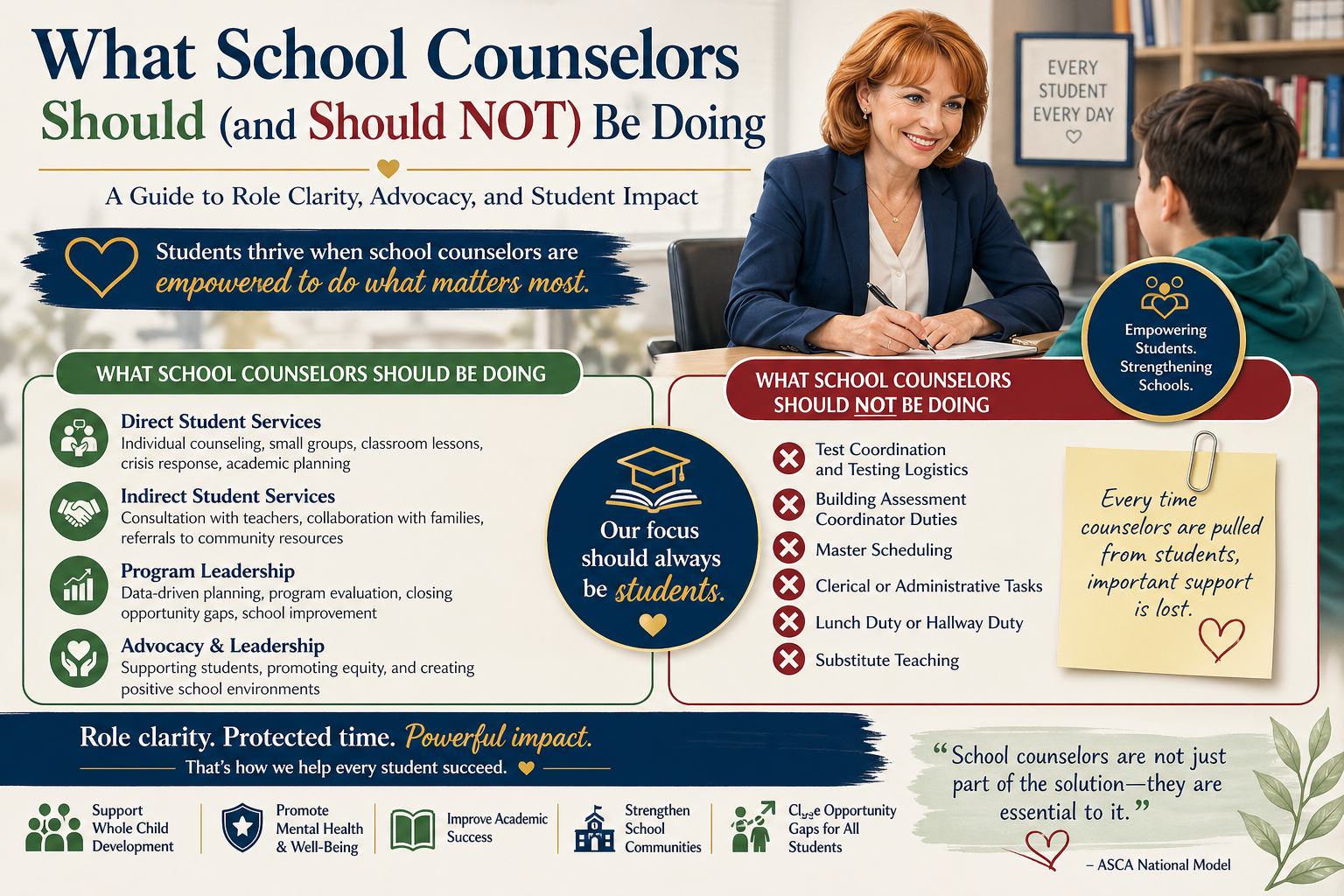
A Guide to Role Clarity, Advocacy, and Student Impact
In schools across the country, one of the greatest barriers to student success is not always a lack of funding, resources, or programs. It is often a lack of clarity about the role of the school counselor.
School counselors are highly trained professionals uniquely positioned to support students academically, socially/emotionally, and in career development. Yet far too often, they are pulled into responsibilities that limit their ability to serve students effectively. While these tasks may support school operations, they come at a cost:
Every moment a school counselor is taken away from students is a missed opportunity to impact lives.
And in a time when student anxiety, behavioral concerns, and mental health needs continue to rise:
Students need school counselors more than ever.
This guide brings together key insights on appropriate roles, common misassignments, and the critical importance of advocacy, so school counselors can do the work they are trained and called to do to create healthier schools and stronger student outcomes.
Why Role Clarity Matters
School counselor role clarity directly impacts students.
When school counselors are able to fully implement a comprehensive school counseling program:
- Mental health needs are addressed
- Academic achievement improves
- School climate strengthens
- Families receive needed support
- Equity gaps begin to close
However, when role confusion exists, the impact is immediate:
- Students have reduced access to counseling services
- Student stress increases and needs go unmet
- Preventative services disappear
- Crisis intervention increases
- Program effectiveness decreases
- Counselor burnout rises
Every time school counselors are pulled away from students, schools lose opportunities to proactively support young people.
The Evolving Role of the Modern School Counselor
Today’s school counselors wear many hats, but those hats should remain student-centered.
Modern school counselors serve as:
Mental Health Advocates
Supporting anxiety, grief, trauma, coping skills, and emotional regulation
Academic Support Leaders
Helping students develop goal-setting, organizational skills, and academic confidence
Career Readiness Facilitators
Helping students explore future pathways
Crisis Responders
Supporting students during school tragedies, community crises, and natural disasters
Family Collaborators
Partnering with caregivers to create wraparound support systems
Social Emotional Learning Leaders
Providing classroom instruction and schoolwide programming
This role has evolved significantly from the historical “guidance counselor” model. Today’s school counselors are leaders of comprehensive systems of support.
What School Counselors SHOULD Be Doing
According to the ASCA National Model, school counselors are most effective when their work focuses on delivering direct and indirect student services.
Direct Student Services
- Individual counseling
- Small group counseling
- Classroom instruction (SEL, coping skills, goal setting)
- Crisis response
- Academic planning
Indirect Student Services
- Consultation with teachers and families
- Collaboration with school teams (MTSS, PBIS)
- Referrals to outside resources
- Advocacy for Student Needs
Program Leadership
- Data-driven decision-making
- Program planning and evaluation
- Closing opportunity gaps
- School improvement collaboration
This is where school counselors create the greatest impact.
What School Counselors SHOULD NOT Be Doing
While school counselors are team players, certain responsibilities fall outside their professional role and reduce their effectiveness. Common Misassignments include:
- Test coordination and logistics (Building Assessment Coordinator duties)
- Master scheduling
- Clerical or administrative tasks
- Lunch or hallway duty
- Substitute teaching
- Discipline assignments unrelated to counseling services
These responsibilities may seem necessary—but they come with a hidden cost:
They take school counselors away from the very students they are meant to serve.
The Hidden Cost of Misaligned Duties
When school counselors are assigned non-counseling tasks:
- Students lose access to mental health support
- Preventative services are reduced
- Crisis response becomes reactive rather than proactive
- Achievement gaps widen
This is especially critical during times like high-stakes testing, when students need increased emotional support, but counselors are often reassigned.
During the very time students often need increased emotional support.
Testing season frequently increases student anxiety, stress, emotional dysregulation, and pressure from adults. Yet counselors are often removed from direct student access.
No test score is more important than student mental health.
Read more:
- The Hidden Cost of Reassigning Counselors During Testing
- Why Being the Building Assessment Coordinator is Problematic
- High-Stakes Testing and Student Mental Health
School Counselor Shortages and Burnout
The national shortage of school counselors continues to create major challenges.
ASCA recommends a 250:1 student-to-counselor ratio. Yet, national averages remain significantly higher.
When shortages combine with inappropriate duties:
- Burnout increases
- Retention declines
- Student needs go unmet
Schools cannot afford to waste counselor time on tasks outside their role.
ASCA National Model Expectations
The ASCA National Model provides clear expectations for school counselors.
It emphasizes:
Define
Mission, vision, student standards
Manage
Use of time assessments, annual agreements, calendars
Deliver
Direct and indirect services
Assess
Data analysis and program improvement
This framework ensures school counselors remain focused on measurable student outcomes.
Advocacy and Leadership: A Professional Responsibility
Advocacy is not optional. It is essential!
School counselors must advocate for:
- Appropriate role alignment
- Student access to mental health support
- Equity in access to services for all students
- Policy decisions that protect students’ mental health and well-being
Leadership may include:
- Educating administrators
- Using data to demonstrate program impact
- Communicating the difference between school counseling and administrative support roles
- Protecting counselor roles
School counselors are not simply service providers. They are systems leaders.
A Whole-Child Perspective
Through the lens of the Balanced Learner framework, school counselors support the full development of students:
- Knowledge & Skills (academic success)
- Dispositions & Mindsets (confidence, motivation)
- Social & Emotional Learning (relationships, coping)
When counselors are removed from their role, this balance is disrupted.
Moving from Role Confusion to Role Clarity
Creating clarity requires intentional action:
For School Counselors:
- Track how time is spent
- Align duties with ASCA recommendations
- Communicate your role consistently
For School Leaders:
- Evaluate counselor responsibilities
- Protect time for student services
- Support a comprehensive counseling program
Final Reflection
School counselors are not schedulers.
They are not testing coordinators.
They are not administrative nor clerical support staff.
They are advocates.
They are leaders.
They are protectors of student well-being.
And when they are allowed to do the work they were trained to do, Students thrive.
Frequently Asked Questions
What is the role of a school counselor?
School counselors provide academic, career, and social/emotional support through a comprehensive, data-driven program aligned with the ASCA National Model.
What are inappropriate duties for school counselors?
Tasks such as test coordination, scheduling, and clerical work that remove counselors from student services.
Should school counselors coordinate testing?
No. While they may assist with accommodations advocacy, full testing coordination is generally outside their appropriate role.
Why does role clarity matter?
Role clarity ensures that school counselors can focus on student needs, leading to improved outcomes in mental health, behavior, and academic success.
Related Resources
- The Many Roles of a School Counselor
- The Hidden Cost of Reassigning Counselors During Testing
- Why Being the Building Assessment Coordinator is Problematic
- High-Stakes Testing and Student Mental Health
- The School Counselor Shortage
- Mental Health Awareness in Schools
- Champion Character: SEL Framework for Schools
