



SCHOOL COUNSELING TODAY
RESEARCH • PRACTICE • WHOLE CHILDREN
High-Stakes Testing and Student Mental Health Guide
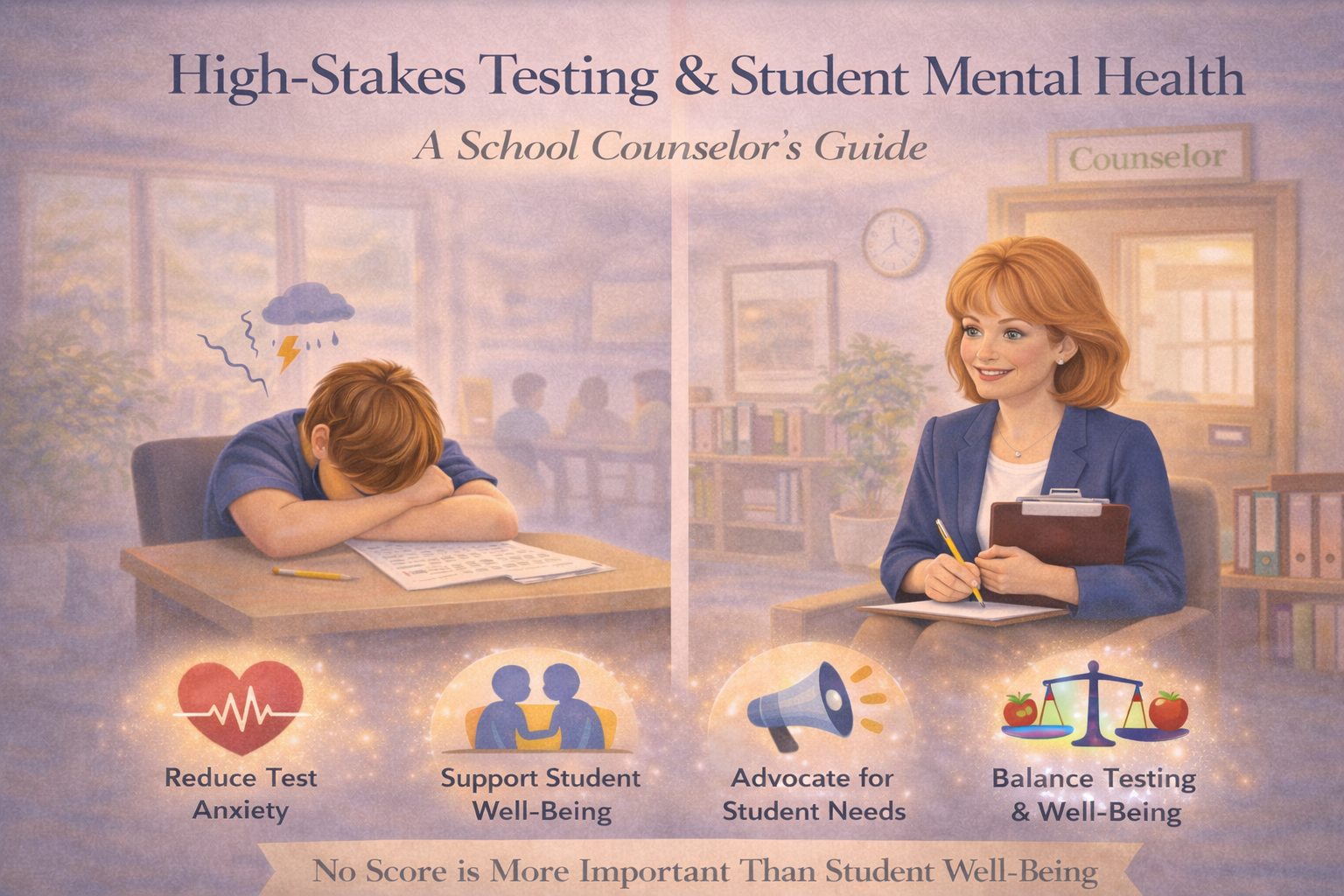
High-stakes testing and student mental health are increasingly connected concerns in today’s schools.
Each spring, schools across the country enter what can feel like a high-pressure season: testing season. While assessments are designed to measure academic progress, they often reveal a deeper tension: the growing divide between accountability and student well-being.
For school counselors, this season presents both a challenge and an opportunity. The challenge is navigating systems that may unintentionally prioritize scores over students. The opportunity is to lead, ensuring that mental health remains at the center of the educational experience.
This guide brings together key insights and strategies to help school counselors support students, advocate for appropriate roles, and promote a balanced approach during high-stakes testing.
Understanding the Impact of High-Stakes Testing on Student Mental Health
High-stakes testing affects more than academic performance. It influences student identity, stress levels, and emotional well-being.
Students may experience:
- Increased anxiety and test-related stress
- Fear of failure or disappointing others
- Physical symptoms (headaches, fatigue, sleep disruption)
- Decreased motivation or disengagement
For some students—especially those already navigating trauma, grief, or mental health challenges—testing can intensify existing struggles.
School counselors play a critical role in helping schools recognize that: No test score is more important than a student’s mental health.
???? Related Post: High-Stakes Testing vs. Student Well-Being
The Role of School Counselors in High-Stakes Testing and Student Mental Health
Testing season often brings role confusion. School counselors may be asked to coordinate testing, manage logistics, or step into roles that limit their ability to serve students directly.
However, according to the ASCA National Model, school counselors are most effective when they focus on:
- Direct student services (counseling, instruction, support)
- Indirect services (consultation, collaboration, advocacy)
- Program implementation and evaluation
During testing, this means:
- Supporting students experiencing anxiety
- Providing classroom guidance on coping strategies
- Consulting with teachers and families
- Advocating for appropriate accommodations
School counselors are not just part of the testing process—they are essential to protecting students within it.
???? Related Post: The Appropriate Role of School Counselors During Testing
Supporting Student Mental Health During High-Stakes Testing
School counselors can proactively support students by integrating social/emotional learning and coping strategies into daily practice.
Practical Strategies:
- Teach test anxiety reduction techniques (deep breathing, positive self-talk)
- Provide brief classroom lessons on stress management
- Offer small groups for students with high anxiety
- Create calm-down spaces or check-in opportunities
- Normalize feelings and reduce stigma around stress
These supports align with both the ASCA National Model and the Champion Character framework, particularly:
- Resilience (I Grow) – helping students persist through challenges
- Belonging (I Care) – ensuring students feel supported and seen
???? Related Post: Mental Health Awareness Month Meets High-Stakes Testing
Finishing Strong: Helping Students Navigate the End of the School Year
Testing often coincides with the end of the school year—a time when students may already feel overwhelmed.
School counselors can help students finish strong by:
- Encouraging a growth mindset rather than perfection
- Helping students reflect on effort and progress, not just outcomes
- Supporting organization, time management, and goal-setting
- Providing encouragement and reassurance
This is a critical moment to reinforce that: Students are more than a score; they are learners, individuals, and works in progress.
???? Related Post: Finishing Strong: How School Counselors Support Students
Advocacy: Balancing Accountability and Student Well-Being
One of the most important roles of the school counselor during testing season is advocacy.
This includes advocating for:
- Appropriate use of counselor time (avoiding over-assignment to testing coordination)
- Student mental health supports during testing windows
- Equitable access to accommodations
- A balanced perspective on assessment data
School counselors serve as a voice for students—ensuring that decisions reflect not only academic goals but also developmental and emotional needs.
A Whole-Child Approach to Testing
Through the lens of the Balanced Learner framework, testing should be viewed as only one component of student development.
A truly effective school system values:
- Knowledge and Skills (academic performance)
- Dispositions and Mindsets (confidence, motivation)
- Social and Emotional Learning (coping, relationships)
When testing overshadows these areas, students lose balance. When counselors lead, balance is restored.
Final Reflection
Testing season does not have to be a time of stress and overwhelm. With intentional leadership, it can become a time of support, growth, and connection.
School counselors are uniquely positioned to ensure that:
- Students feel supported
- Mental health is prioritized
- Schools remain focused on the whole child
Because in the end: No test is more important than the well-being of the student taking it.
Continue Exploring
- High-Stakes Testing vs. Student Well-Being
- The Appropriate Role of School Counselors During Testing
- Mental Health Awareness Month Meets High-Stakes Testing
- Finishing Strong: Supporting Students at the End of the Year
Frequently Asked Questions
How does high-stakes testing affect student mental health?
High-stakes testing can increase anxiety, stress, and pressure, especially for students already facing academic or emotional challenges.
What can school counselors do during testing season?
School counselors support student mental health by teaching coping strategies, providing small group support, and advocating for student needs.
CONTINUE EXPLORING COUNSELING TODAY
Explore more research-informed ideas, practical resources, and professional learning for supporting students and strengthening school counseling practice.
ARTICLES
Read perspectives, practical guidance, and ideas for strengthening school counseling practice.
PROFESSIONAL LEARNING LIBRARY
Explore frameworks, tools, research, and learning resources.
COUNSELING TODAY
Return to Counseling Today to explore professional learning, signature resources, and more.