



Use the existing subtitle exactly as it appears on your banner
School Counseling Practice & Leadership

Welcome to School Counseling Practice & Leadership
School counseling is a profession defined not merely by the responsibilities assigned to its practitioners, but by the purpose those responsibilities are intended to serve.
At its foundation, school counseling is about students—their development, well-being, opportunities, and success. School counselors are school-based mental health professionals whose responsibilities extend beyond mental health support to encompass students' academic, career, and social-emotional development.
Fulfilling that purpose requires more than a willingness to help. It requires a clear understanding of professional identity, a commitment to comprehensive school counseling programs, and the knowledge and judgment to distinguish appropriate professional responsibilities from tasks that may divert time and attention from students.
Protecting the school counselor's professional role is not simply about protecting a position. It is about protecting students' access to the services that position was designed to provide.
Professional identity, leadership, and advocacy are therefore inseparable from effective school counseling practice. Understanding who we are helps us recognize what we are called upon to accomplish. Upholding professional principles guides our decisions when competing expectations arise. Intentional practice ensures that our time, expertise, and energy are directed toward meaningful student outcomes.
This journal brings together articles exploring the foundations of the school counselor's role, the responsibilities of professional leadership and advocacy, and the everyday practices through which school counselors serve their students and school communities.
The collection is organized into three reading paths.
Professional identity defines our purpose. Advocacy protects our purpose. Intentional practice fulfills our purpose.
Explore the Reading Paths
Understanding the School Counselor's Role & Program
Explore professional identity, comprehensive programs, and the services students need.
Leadership, Advocacy & Professional Practice
Discover how leadership and advocacy preserve students' access to school counseling.
Seasonal & Practical Resources
Find purposeful resources for the opportunities and responsibilities of the school year.
Looking for a particular topic?
Prefer to browse by subject rather than follow a guided reading path? Explore the School Counseling Practice & Leadership Article Collection to find articles on professional identity, comprehensive school counseling programs, leadership, advocacy, and practical resources.
Understanding the School Counselor's Role & Program
Professional Identity Provides the Foundation for Effective Practice
Professional identity protects student access.
Understanding the school counselor's role begins with understanding the purpose of the profession. School counselors are school-based mental health professionals whose responsibilities extend beyond mental health support to encompass students' academic, career, and social-emotional development.
A comprehensive school counseling program provides the structure through which these responsibilities become coordinated, intentional services rather than a collection of unrelated activities.
Yet the school counselor's role is not always clearly understood. Competing expectations, historical practices, and the willingness of school counselors to help wherever needed can blur the distinction between appropriate professional responsibilities and tasks that divert attention from students.
A clear professional identity helps school counselors explain their work, collaborate effectively with school communities, and advocate for the time and resources necessary to provide meaningful student services.
The articles in this reading path explore the foundations of the profession, clarify the responsibilities of school counselors, and demonstrate why comprehensive school counseling programs are essential to student success.
Knowing who we are helps us remain faithful to whom we serve.
01 · WHO WE ARE

Establishes the school counselor's professional identity and essential contribution to student development.
02 · WHAT WE DO
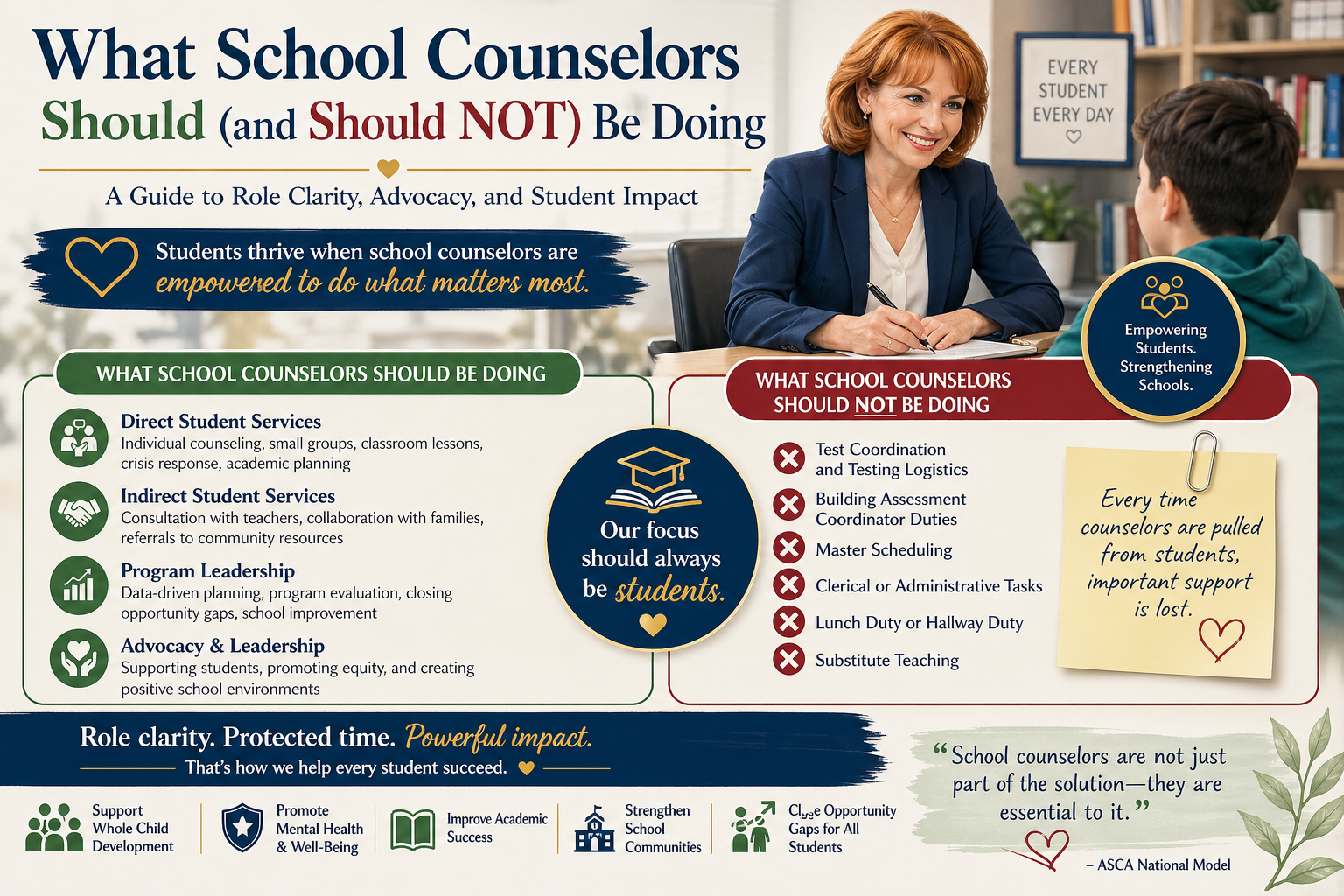
Clarifies appropriate professional responsibilities and the importance of protecting student-serving time.
03 · WHY OUR ROLE MATTERS

Explores the school counselor's vital mental health responsibilities within a comprehensive developmental role.
Continue Exploring
Article
Contribution
Understanding everyday professional responsibilities
Clarifying related but distinct professional roles
Reflecting on the dimensions of professional service
Connecting responsibilities to student needs
Identifying meaningful outcomes for students
Understanding program-wide benefits
Connecting comprehensive counseling to whole-child development
Reading Path Two
Leadership, Advocacy & Professional Practice
Leading with Purpose. Advocating with Integrity. Serving Students.
Professional advocacy preserves student access.
School counselors are called to lead within educational environments where competing priorities, limited resources, and evolving expectations can influence how their professional time is used. Effective leadership begins with a clear understanding of the profession's purpose and a commitment to ensuring that students receive the services they need.
Professional advocacy is sometimes misunderstood as an effort to protect positions, limit responsibilities, or resist collaboration. In reality, meaningful advocacy is grounded in the needs of students. When school counselors communicate their professional responsibilities, establish appropriate boundaries, and participate in decisions about school practices, they help preserve access to comprehensive school counseling services.
Leadership does not depend on an administrative title. It is demonstrated through informed decision-making, ethical practice, professional collaboration, and the willingness to address conditions that interfere with student support.
This distinction becomes especially important when responsibilities are assigned for convenience rather than professional purpose. School counselors may be capable of performing many tasks, but their ability to complete those tasks does not necessarily make them the most appropriate professionals to assume them.
The articles in this reading path examine professional identity, leadership, advocacy, and the everyday decisions that shape school counseling practice. Together, they encourage school counselors to approach professional responsibilities with both confidence and accountability.
We don't advocate for the profession at the expense of students. We advocate for the profession on behalf of students.
01 · DEFINING OUR PURPOSE

Examines how professional identity develops and why it provides the foundation for confident leadership and meaningful advocacy.
02 · LEADING WITH PURPOSE

Explores how school counselors can exercise leadership in strengthening school-based mental health support and promoting student well-being.
03 · ADVOCATING FOR STUDENT ACCESS

Illustrates how inappropriate assignments can redirect professional resources away from students and why role advocacy matters.
Continue Exploring
Article
Contribution
Examining professional standards and responsibilities
Balancing professional history with evolving expectations
Understanding the counselor's influence within schools
Considering workforce challenges and student access
Strengthening professional communication and collaboration
Building confidence and judgment in early practice
Recognizing professional community as a leadership resource
Reflecting on the profession's broader influence
Reading Path Three
Seasonal & Practical Resources
Intentionality is the bridge between purpose and practice.
Purpose gives seasonal activities their meaning.
The school year brings a natural rhythm of beginnings, transitions, celebrations, challenges, and opportunities for reflection. Each presents possibilities for school counselors to support students, strengthen relationships, and contribute to a positive school environment.
Yet meaningful school counseling is not defined by the number of activities completed, programs introduced, or responsibilities assumed. It is defined by the purpose those efforts serve and their contribution to student development and well-being.
Intentional practice recognizes that time, attention, and professional energy are valuable resources. When school counselors approach their responsibilities with a clear purpose, they can reduce unnecessary demands, make thoughtful decisions, and devote more of their attention to the students they serve.
Efficiency helps us use our time wisely. Intentionality helps us use it meaningfully.
This distinction matters. Completing a task efficiently has little professional value if the task itself does not contribute to a meaningful objective. Intentional school counseling begins by considering the student need, identifying the desired outcome, and selecting practices that are appropriate to that purpose.
The articles in this reading path offer seasonal guidance, practical activities, and professional reflections organized around the natural progression of the academic year. Rather than treating the school calendar as a checklist of activities, they encourage school counselors to approach each opportunity thoughtfully.
Our goal is not simply to accomplish more. It is to ensure that what we accomplish matters.
We cannot teach intentional living as effectively if we are not practicing it ourselves.
01 · PLAN WITH PURPOSE

Establishing priorities, building relationships, and beginning the academic year with a clear professional purpose.
02 · RESPOND WITH INTENTION

Anticipating student needs and providing thoughtful support during seasonal transitions and school breaks.
03 · REFLECT ON IMPACT
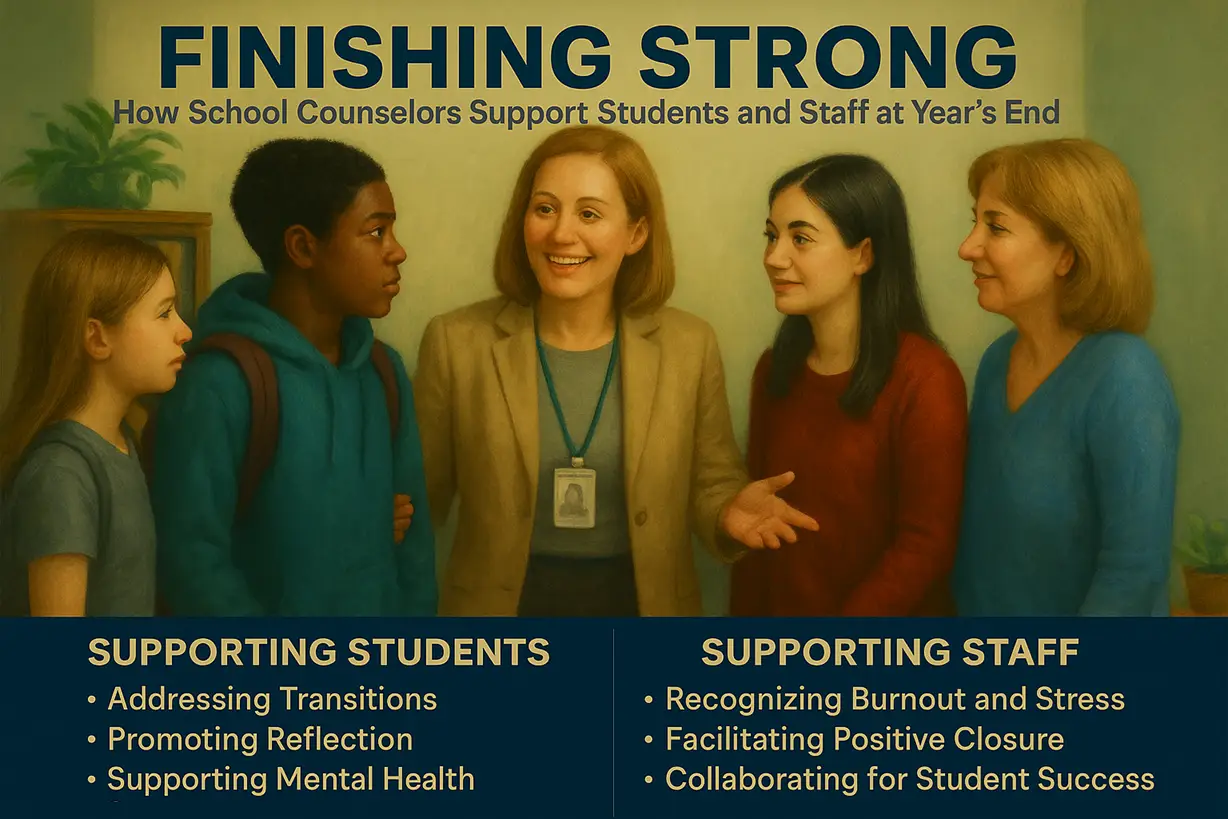
Explores how school counselors can support students and staff, recognize growth, and conclude the school year with intention.
Continue Exploring
The following resources are organized around the natural rhythm of the academic year. They are offered as opportunities for thoughtful professional practice, not as a checklist of activities to complete.
Each resource invites school counselors to consider the developmental needs of their students, the objectives of their comprehensive school counseling program, and the most meaningful use of their professional time.
The calendar may present the opportunity. Student needs should determine the response.
Beginning the Year: Establishing Purpose and Professional Presence
Article
Contribution
Recognizing professional contributions and responsibilities
Connecting seasonal activities with meaningful learning
Fall: Creating Meaningful Opportunities for Learning
Article
Contribution
Using seasonal themes to support student development
Extending seasonal learning through engaging activities
Offering additional opportunities for purposeful engagement
Applying professional judgment during holiday activities
Encouraging gratitude, reflection, and positive relationships
Winter: Supporting Students Through Transitions and Celebrations
Article
Contribution
Maintaining professional purpose during seasonal celebrations
Selecting developmentally meaningful winter activities
Supporting students through changes and new beginnings
Reassessing priorities and renewing professional focus
Winter into Spring: Strengthening Belonging and Recognizing the Profession
Article
Contribution
Promoting understanding and recognition of the profession
Encouraging kindness, belonging, and positive relationships
Reinforcing compassion through purposeful activities
How the Three Reading Paths Fit Together
Understand
The role, the program, and the services
Explore
Leadership and advocacy
Apply
Resources for purposeful practice